Congenital insensitivity to pain (CIP) is an extremely rare syndrome with various clinical features, characterized by a dramatic impairment of pain perception since birth. Although many genes are known to cause this condition, SCN9A-related disease remains underrecognized, and affected individuals cannot perceive pain despite preserved tactile sensation, predisposing them to repeated unnoticed injuries, fractures, burns, and joint deformities. Here, we report two siblings with genetically confirmed SCN9A-related type 1 CIP: the first is a female patient who experienced fractures with delayed detection, anosmia, recurrent hand and foot inflammation, and life-long absence of pain response, while the second is her brother, who demonstrated similar features along with progressive lower-limb deformity, limb-length discrepancy, and multiple soft-tissue injuries resulting from unrecognized trauma; both had unremarkable perinatal and developmental histories. These findings illustrate that CIP remains a rare and diagnostically challenging condition, highlighting clinical features that can guide early identification, including lack of pain perception, recurrent trauma, painless inflammatory episodes, and preserved non-nociceptive sensation; genetic testing plays a central role in confirming the diagnosis, and long-term management requires multidisciplinary care, regular radiological monitoring, and comprehensive family education to reduce preventable complications. Overall, this case series highlights a rare familial neurological condition in which early recognition and treatment can make a meaningful difference in preventing progressive deformity and disability, and increasing awareness of this uncommon condition may improve diagnostic timing and patient outcomes.
This is an Open Access article, distributed under the terms of the Creative Commons Attribution 4.0 International License (http://creativecommons.org/licenses/by/4.0/), which permits unrestricted use, distribution and reproduction in any medium or format, provided the original work is properly cited.
Hereditary sensory and autonomic neuropathies (HSANs) are a group of diverse neurogenetic disorders characterized by progressive sensory and autonomic dysfunction. When the onset began from birth, it’s termed congenital insensitivity to pain (CIP). HSANs are subclassified into at least 8 types according to the underlying genetic mutation, inheritance pattern, and clinical features
[2]
Schwartzlow C, Kazamel M. Hereditary Sensory and Autonomic Neuropathies: Adding More to the Classification. Curr Neurol Neurosci Rep. 2019 Aug; 19(8): 52.
More than 22 genes have been discovered, and novel mutations are still being reported in the literature. Genetic mutations affect the process of signal transduction in the neurons, leading to failure of delivery of sensory input to the brain, including pain signals (nociception)
[3]
Lischka A, Eggermann K, Record CJ, Dohrn MF, Laššuthová P, Kraft F, et al. Genetic landscape of congenital insensitivity to pain and hereditary sensory and autonomic neuropathies. Brain. 2023 Dec 1; 146(12): 4880–90.
Although CIP is present from birth by definition, the broader group of HSANs can manifest shortly after birth or present years later depending on the subtype. Insensitivity to pain results in the development of various types of traumas, including musculoskeletal injuries, joint deformities, painless fractures, burns, loss of teeth, and self-mutilation. Additionally, many patients can develop anosmia and autonomic dysfunction and cognitive function can be normal or disabled
[2]
Schwartzlow C, Kazamel M. Hereditary Sensory and Autonomic Neuropathies: Adding More to the Classification. Curr Neurol Neurosci Rep. 2019 Aug; 19(8): 52.
Yuan J, Matsuura E, Higuchi Y, Hashiguchi A, Nakamura T, Nozuma S, et al. Hereditary sensory and autonomic neuropathy type IID caused by an SCN9A mutation. Neurology. 2013 Apr 30; 80(18): 1641–9.
SCN9A gene contributes to the function of voltage-gated sodium channels in the sensory neurons. Loss of function mutation leads to development of HSAN IID, characterized by congenital insensitivity to pain and anosmia. Diagnosis is confirmed through the identification of biallelic null mutations in the SCN9A gene, resulting in the absence of functional Nav1.7 protein that is expressed in pain-sensing neurons
[5]
Drenth JPH, Waxman SG. Mutations in sodium-channel gene SCN9A cause a spectrum of human genetic pain disorders. J Clin Invest. 2007 Dec 3; 117(12): 3603–9.
In our study we described a pathogenic homozygous c.901A>T mutation in the SCN9A gene in 2 Palestinian siblings. This case series tries to add new knowledge to this ultrarare group of diseases.
2. Case Reports
2.1. Patient 1
A 10-year-old girl was presented to the surgical unit two hours after falling from the second floor. Despite the mechanism of injury, she reported no pain. She was unable to bear weight and exhibited limping. Physical examination revealed limited range of motion of the right hip, external rotation, and limb shortening, while the remainder of the systemic examination was unremarkable. Vital signs were within normal limits, and developmental milestones were age-appropriate, including normal cognitive function. Neurological assessment demonstrated intact cranial nerves, normal tone, preserved muscle strength and tendon reflexes, and normal light touch, vibration, and proprioception, with palpable distal pulses.
She was born at term via spontaneous vaginal delivery to first cousin parents and did not cry immediately after birth. Her condition remained unrecognized until the age of five years, when her parents noted recurrent unexplained burns, wounds, and multiple fractures without pain expression. Most injuries involved the lower limbs and often did not require surgical intervention.
Additional history included early tooth loss, anosmia, recurrent unexplained febrile episodes, excessive sweating, and absence of crying during trauma. Despite preserved tactile sensation, she exhibited urinary incontinence and recurrent episodes of knee and ankle infections, some of which required aspiration and incision with drainage. She ambulated independently prior to the current injury; however, repeated trauma had significantly interrupted her school attendance. Family history was notable for one sibling with a similar phenotype. Nerve conduction studies (NCSs) were normal.
Whole-exome sequencing (WES) was performed and revealed the presence of c.901A>T mutation that creates a stop codon at lysine 301 in the SCN9A gene. WES was performed for the whole family and revealed the same mutation of the SCN9A gene in the older brother (12 years old) who had a homozygous mutation and manifested the disease (described below), and a heterozygous mutation in the younger brother and both parents, who were healthy.
Radiographic imaging confirmed a right femoral neck fracture (Figure 1A), for which she underwent open reduction and internal fixation (ORIF) with cannulated screws. Her orthopedic history was significant for recurrent fractures. One month prior to the current presentation, she sustained a left femoral neck fracture after a ground-level fall (Figure 1B); due to absent pain perception, the injury went unrecognized and was discovered one day later during evaluation for limping. This fracture was also treated successfully with ORIF using cannulated screws (Figure 1C). Additionally, she had previously experienced a proximal humerus fracture managed conservatively with closed reduction and an arm sling (Figure 1D).
Figure 1. A showed a right femoral neck fracture, along with screws at the left previously fractured femoral neck. B and C showed left femoral neck fracture that was repaired surgically by screws. D showed right humeral neck fracture. Red arrows denote the fracture site, while blue arrows indicate the location of surgical repair.
2.2. Patient 2
A 12-year-old boy with genetically confirmed CIP due to an SCN9A-related disorder was born at term following an uncomplicated pregnancy and spontaneous vaginal delivery. Similar to his affected sister, he did not cry at birth. His lack of pain perception was recognized before the age of one year when he presented with an incarcerated abdominal hernia without any signs of distress; he underwent laparotomy, hernia repair, creation of a colostomy, and later colostomy closure. Throughout early childhood, and similar to his sister, his parents reported multiple fractures, burns, and skin wounds that occurred without pain expression, affecting both the lower and upper extremities. Most of these injuries did not require surgical intervention, and he experienced recurrent skin infections of the hands and feet due to unrecognized traumas, along with episodes of swelling and fractures around the knees.
Additional clinical features included complete anosmia, recurrent unexplained febrile episodes, excessive sweating particularly with heat or physical exertion, urinary incontinence, and preserved light-touch sensation. In contrast to his sister, he did not exhibit premature tooth loss but had documented visual problems, likely due to corneal injury. Developmental milestones and intellectual function were normal. Motor development was normal as well, and he achieved independent ambulation without delay; however, the frequency of unrecognized injuries significantly affected his school attendance and learning. NCSs were normal, consistent with the characteristic neurophysiological profile of SCN9A-related congenital insensitivity to pain.
At the age of seven years, he was presented with progressive left knee deformity and limb length discrepancy of 4 cm following repeated injuries in the same region. On physical examination at that time, he exhibited a limping gait with intermittent tip-toe walking and internal tibial torsion. Both knees had a good range of movement, and there were abrasions and healed ulcers over their anterior surfaces. The medial and lateral collateral ligaments were stable, the distal neurovascular examination was intact, and no effusion, warmth, or redness was noted in the affected knee.
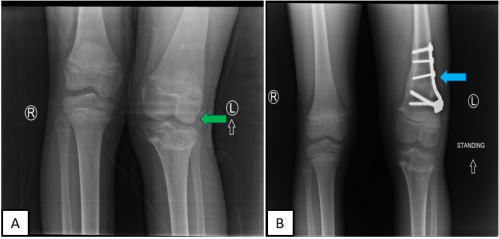
Figure 2. A showed genu valgus deformity of the left knee (green arrow) and B showed post repair lateral distal femoral open-wedge osteotomy (blue arrow).
Radiographs demonstrated a progressive genu valgus deformity (Figure 2A) for which he subsequently underwent lateral distal femoral open-wedge osteotomy (Figure 2B). Years later, his parents noted worsening limb-length discrepancy and recurrence of the deformity. Repeat radiographic evaluation confirmed the return of the valgus malalignment, and he later underwent a second corrective osteotomy with Ilizarov external fixation. Follow-up radiographs after the second surgery demonstrated approximately 6 cm of lengthening in the affected limb.
3. Discussion
HSANs are a group of diverse inherited neurological disorders characterized by progressive sensory and autonomic dysfunction of the peripheral nervous system, with or without central sparing. The onset of manifestations can be as early as birth or can be delayed for years. As the name implies, CIP is a subgroup of HSANs characterized by onset from birth
[2]
Schwartzlow C, Kazamel M. Hereditary Sensory and Autonomic Neuropathies: Adding More to the Classification. Curr Neurol Neurosci Rep. 2019 Aug; 19(8): 52.
Common to all types of HSANs, loss of sensation is regarded as the primary mechanism by which the symptoms and signs manifest. As is known, pain (nociception) is an important protective reflex against tissue injury. When lost, the body becomes exposed to repeated tissue injuries along with failure of healing. Loss of teeth, self-mutilation, biting off fingertips, loss of the tongue tip, burns, painless fractures, joint damage and deformities (Charcot joints), and corneal injuries can occur. On the other hand, some types of HSANs are associated with autonomic dysfunction that manifests as orthostatic hypotension with lack of compensatory tachycardia. Moreover, anhidrosis (lack of sweating) can occur and can lead to recurrent episodes of unexplained fever. Additionally, intellectual function can be normal or can be disabled. Of importance, diagnosis of HSANs can be difficult before the age of 5 years, and the patients often present with pictures of complications
[2]
Schwartzlow C, Kazamel M. Hereditary Sensory and Autonomic Neuropathies: Adding More to the Classification. Curr Neurol Neurosci Rep. 2019 Aug; 19(8): 52.
Lischka A, Eggermann K, Record CJ, Dohrn MF, Laššuthová P, Kraft F, et al. Genetic landscape of congenital insensitivity to pain and hereditary sensory and autonomic neuropathies. Brain. 2023 Dec 1; 146(12): 4880–90.
Primary mechanisms are disorders of development of nociceptors, altered electrical activity of nociceptors, or neurodegeneration of peripheral nerves. These mechanisms ultimately disrupt the sodium-channel-mediated depolarization required to generate an action potential and transmit pain signals
[7]
Freeman SA, Desmazières A, Fricker D, Lubetzki C, Sol-Foulon N. Mechanisms of sodium channel clustering and its influence on axonal impulse conduction. Cell Mol Life Sci. 2016 Feb; 73(4): 723–35.
Freeman SA, Desmazières A, Simonnet J, Gatta M, Pfeiffer F, Aigrot MS, et al. Acceleration of conduction velocity linked to clustering of nodal components precedes myelination. Proc Natl Acad Sci [Internet]. 2015 Jan 20 [cited 2025 Nov 16]; 112(3). Available from:
The SCN9A gene stands for sodium voltage-gated channel alpha subunit 9. By gene expression, the SCN9A gene contributes to the alpha subunit of the sodium channel NaV1.7 that is found in the pain-sensing neuron (nociceptor) that is expressed mainly in the dorsal root ganglion and sympathetic ganglion neurons and their small-diameter peripheral axons. Axons of these neurons extend through the spinal cord to the brain, where they communicate with the target cells to produce the sense of pain. Additionally, NaV1.7 sodium channels are present in the olfactory neurons that are responsible for transmitting smell-related signals to the brain.
Loss of function mutation of the SCN9A gene leads to production of the nonfunctional alpha subunit of the NaV1.7 sodium channel (sodium channelopathy), and therefore insensitivity to pain and anosmia by defect of generation of action potentials in these neurons. On the other hand, gain-of-function mutation causes neuronal hyperexcitability, leading to other allelic disorders such as simple febrile seizures, paroxysmal extreme pain disorder, and erythromelalgia
[2]
Schwartzlow C, Kazamel M. Hereditary Sensory and Autonomic Neuropathies: Adding More to the Classification. Curr Neurol Neurosci Rep. 2019 Aug; 19(8): 52.
Drenth JPH, Waxman SG. Mutations in sodium-channel gene SCN9A cause a spectrum of human genetic pain disorders. J Clin Invest. 2007 Dec 3; 117(12): 3603–9.
Hoeijmakers J, Merkies I, Gerrits M, Waxman S, Faber C. Genetic aspects of sodium channelopathy in small fiber neuropathy. Clin Genet. 2012 Oct; 82(4): 351–8.
Based on the mode of inheritance, genetic mutation, and phenotype, HSANs can be classified into types with further subtypes. Many types were described in the literature, and novel mutations and clinical presentation are still being discovered. The mode of inheritance can be autosomal dominant or autosomal recessive, and they are numbered from (HSAN I- VIII). More than 22 genes have been identified
[3]
Lischka A, Eggermann K, Record CJ, Dohrn MF, Laššuthová P, Kraft F, et al. Genetic landscape of congenital insensitivity to pain and hereditary sensory and autonomic neuropathies. Brain. 2023 Dec 1; 146(12): 4880–90.
Of importance, HSAN Type II is an autosomal recessive disorder that was first described in a Canadian family in 1973. According to the mutated gene, it can be subclassified into HSAN-IIA, HSAN-IIB, HSAN-IIC, and HSAN-IID. HSAN-IID, also known as CIP1, is caused by mutation of the SCN9A gene described earlier. As the name implies, the manifestations appear with birth, such as absence of crying with birth
[2]
Schwartzlow C, Kazamel M. Hereditary Sensory and Autonomic Neuropathies: Adding More to the Classification. Curr Neurol Neurosci Rep. 2019 Aug; 19(8): 52.
Yuan J, Matsuura E, Higuchi Y, Hashiguchi A, Nakamura T, Nozuma S, et al. Hereditary sensory and autonomic neuropathy type IID caused by an SCN9A mutation. Neurology. 2013 Apr 30; 80(18): 1641–9.
. Autonomic involvement is mainly seen in HSAN-I, III, IV, and VI. It was absent in our patients
[2]
Schwartzlow C, Kazamel M. Hereditary Sensory and Autonomic Neuropathies: Adding More to the Classification. Curr Neurol Neurosci Rep. 2019 Aug; 19(8): 52.
. Intellectual disability was not observed in SCN9A-associated neuropathy but can be seen in other HSANs. Additionally, any child with anosmia and normal intellectual function should be tested for SCN9A mutation
[3]
Lischka A, Eggermann K, Record CJ, Dohrn MF, Laššuthová P, Kraft F, et al. Genetic landscape of congenital insensitivity to pain and hereditary sensory and autonomic neuropathies. Brain. 2023 Dec 1; 146(12): 4880–90.
Richards S, Aziz N, Bale S, Bick D, Das S, Gastier-Foster J, et al. Standards and guidelines for the interpretation of sequence variants: a joint consensus recommendation of the American College of Medical Genetics and Genomics and the Association for Molecular Pathology. Genet Med. 2015 May; 17(5): 405–24.
Patients can have painless injuries, anosmia, hyperhidrosis, and urinary incontinence, as seen in our patients. Decreased corneal reflexes were seen in the brother; however, the sister didn’t have them. This underscores that even with the same inherited genotype, the phenotype can differ between the patients in this genetic disorder. Additionally, joint deformities can develop, such as genu valgus in the brother. In our study, the parents were first-cousin relatives and harbored the same genetic mutation. This emphasizes that suspicion of such neurological disorders should be high in relatives, given that the likelihood of having affected offspring is 25% in heterozygous parents. The literature review of similar cases is summarized in Table 1. This pathologic genetic variant has been reported only in Palestine. These findings also carry direct clinical relevance for orthopedic follow-up, since progressive limb deformity and length discrepancy, as seen in the brother, may continue to evolve despite corrective surgery and therefore warrant long-term radiographic monitoring. Genetic confirmation additionally allows for informed genetic counseling of the extended family, including carrier testing of at-risk relatives and discussion of the 25% recurrence risk in future pregnancies of carrier couples, an important and often underemphasized aspect of the clinical management of SCN9A-related CIP.
Table 1. Similar reported cases of the same mutation in the SCN9A gene along with comparison of the relevant points.
#
Title
Gene variant
Age
Sex
Ethnicity
Year
Clinical Presentation / Notes
1
Identification of founder and novel mutations that cause congenital insensitivity to pain (CIP) in palestinian patients
[15]
Khaled B, Alzahayqa M, Jaffal A, Sallam H, Thawabta R, Mansour M, et al. Identification of founder and novel mutations that cause congenital insensitivity to pain (CIP) in palestinian patients. BMC Med Genomics. 2023 May 30; 16(1): 120.
2 patients (7 years-old male, and 8 year-old female)
Male Female
Palestinians
2023
Anosmia CIP Recurrent infections Parents and one sibling were carrier and free of symptoms Normal intellectual function
2
Congenital Insensitivity to Pain: A Case Study of a Rare Genetic Disorder
[16]
Al-Hroub NN, Al-Salahat AA, Taamreh MA, Abunejma FM, Dukmak ON. Congenital Insensitivity to Pain: A Case Study of a Rare Genetic Disorder. Cureus [Internet]. 2024 Sept 14 [cited 2025 Nov 16]; Available from:
In HSAN IID, NCSs are mostly normal or slightly reduced (measured by compound muscle action potentials [CMAP] and sensory nerve conduction velocity [SCV])
[4]
Yuan J, Matsuura E, Higuchi Y, Hashiguchi A, Nakamura T, Nozuma S, et al. Hereditary sensory and autonomic neuropathy type IID caused by an SCN9A mutation. Neurology. 2013 Apr 30; 80(18): 1641–9.
A multidisciplinary team is crucial for the management of this condition. The neurologist, dermatologist, physical and occupational therapists, prosthetics, and orthopedic surgeons are needed for optimal healthcare
[12]
Kazachkov M, Palma JA, Norcliffe-Kaufmann L, Bar-Aluma BE, Spalink CL, Barnes EP, et al. Respiratory care in familial dysautonomia: Systematic review and expert consensus recommendations. Respir Med. 2018 Aug; 141: 37–46.
Treatment of HSANs is generally supportive. However, certain types can benefit from pharmacological interventions, such as gene-modifying therapies that enhance gene expression in HSAN-III
[2]
Schwartzlow C, Kazamel M. Hereditary Sensory and Autonomic Neuropathies: Adding More to the Classification. Curr Neurol Neurosci Rep. 2019 Aug; 19(8): 52.
Lee G, Papapetrou EP, Kim H, Chambers SM, Tomishima MJ, Fasano CA, et al. Modelling pathogenesis and treatment of familial dysautonomia using patient-specific iPSCs. Nature. 2009 Sept; 461(7262): 402–6.
. However, effective pharmacological interventions are still lacking in HSAN-IID.
4. Conclusion
This case series highlights a rare familial neurological condition. Early recognition and treatment can make a meaningful difference in preventing progressive deformity and disability. Increasing awareness of this uncommon condition may improve diagnostic timing and patient outcomes.
Abbreviations
CIP
Congenital Insensitivity to Pain
CMAP
Compound Muscle Action Potentials
HSANs
Hereditary Sensory and Autonomic Neuropathies
NCS
Nerve Conduction Studies
ORIF
Open Reduction and Internal Fixation
SCN9A
Sodium Voltage-Gated Channel Alpha Subunit 9
SCV
Sensory Nerve Conduction Velocity
WES
Whole-Exome Sequencing
Acknowledgments
We thank the patients and their families for their participation and cooperation.
Author Contributions
Mohammed Alra'e: Conceptualization, Project administration, Writing – original draft, Writing – review & editing
Qossay Hasasneh: Writing – original draft
Hadeel Halahla: Writing – original draft
Ibrahim Kattoush: Writing – original draft
Zaid Abu Aisha: Supervision
Anas Bayyoudqasrawi: Supervision
Abdulhaq Shaheen: Supervision
Mohammad Saya’reh: Writing – original draft
Data Availability Statement
All data supporting the study's findings are included in the article and are readily accessible.
Conflicts of Interest
The authors declare no conflicts of interest.
References
[1]
Gagnier JJ, Kienle G, Altman DG, Moher D, Sox H, Riley D, et al. The CARE guidelines: consensus-based clinical case reporting guideline development. BMJ Case Rep. 2013 Oct 23; 2013: bcr2013201554.
Schwartzlow C, Kazamel M. Hereditary Sensory and Autonomic Neuropathies: Adding More to the Classification. Curr Neurol Neurosci Rep. 2019 Aug; 19(8): 52.
Lischka A, Eggermann K, Record CJ, Dohrn MF, Laššuthová P, Kraft F, et al. Genetic landscape of congenital insensitivity to pain and hereditary sensory and autonomic neuropathies. Brain. 2023 Dec 1; 146(12): 4880–90.
Yuan J, Matsuura E, Higuchi Y, Hashiguchi A, Nakamura T, Nozuma S, et al. Hereditary sensory and autonomic neuropathy type IID caused by an SCN9A mutation. Neurology. 2013 Apr 30; 80(18): 1641–9.
Drenth JPH, Waxman SG. Mutations in sodium-channel gene SCN9A cause a spectrum of human genetic pain disorders. J Clin Invest. 2007 Dec 3; 117(12): 3603–9.
Freeman SA, Desmazières A, Fricker D, Lubetzki C, Sol-Foulon N. Mechanisms of sodium channel clustering and its influence on axonal impulse conduction. Cell Mol Life Sci. 2016 Feb; 73(4): 723–35.
Freeman SA, Desmazières A, Simonnet J, Gatta M, Pfeiffer F, Aigrot MS, et al. Acceleration of conduction velocity linked to clustering of nodal components precedes myelination. Proc Natl Acad Sci [Internet]. 2015 Jan 20 [cited 2025 Nov 16]; 112(3). Available from:
Hoeijmakers J, Merkies I, Gerrits M, Waxman S, Faber C. Genetic aspects of sodium channelopathy in small fiber neuropathy. Clin Genet. 2012 Oct; 82(4): 351–8.
Richards S, Aziz N, Bale S, Bick D, Das S, Gastier-Foster J, et al. Standards and guidelines for the interpretation of sequence variants: a joint consensus recommendation of the American College of Medical Genetics and Genomics and the Association for Molecular Pathology. Genet Med. 2015 May; 17(5): 405–24.
Lee G, Papapetrou EP, Kim H, Chambers SM, Tomishima MJ, Fasano CA, et al. Modelling pathogenesis and treatment of familial dysautonomia using patient-specific iPSCs. Nature. 2009 Sept; 461(7262): 402–6.
Khaled B, Alzahayqa M, Jaffal A, Sallam H, Thawabta R, Mansour M, et al. Identification of founder and novel mutations that cause congenital insensitivity to pain (CIP) in palestinian patients. BMC Med Genomics. 2023 May 30; 16(1): 120.
Al-Hroub NN, Al-Salahat AA, Taamreh MA, Abunejma FM, Dukmak ON. Congenital Insensitivity to Pain: A Case Study of a Rare Genetic Disorder. Cureus [Internet]. 2024 Sept 14 [cited 2025 Nov 16]; Available from:
Alra'e, M., Hasasneh, Q., Halahla, H., Kattoush, I., Aisha, Z. A., et al. (2026). Clinical and Genetic Characterization of Two Siblings with SCN9A-Related Congenital Insensitivity to Pain Type 1: Two Case Reports. World Journal of Medical Case Reports, 7(3), 34-39. https://doi.org/10.11648/j.wjmcr.20260703.11
Alra'e, M.; Hasasneh, Q.; Halahla, H.; Kattoush, I.; Aisha, Z. A., et al. Clinical and Genetic Characterization of Two Siblings with SCN9A-Related Congenital Insensitivity to Pain Type 1: Two Case Reports. World J. Med. Case Rep.2026, 7(3), 34-39. doi: 10.11648/j.wjmcr.20260703.11
Alra'e M, Hasasneh Q, Halahla H, Kattoush I, Aisha ZA, et al. Clinical and Genetic Characterization of Two Siblings with SCN9A-Related Congenital Insensitivity to Pain Type 1: Two Case Reports. World J Med Case Rep. 2026;7(3):34-39. doi: 10.11648/j.wjmcr.20260703.11
@article{10.11648/j.wjmcr.20260703.11,
  author = {Mohammed Alra'e and Qossay Hasasneh and Hadeel Halahla and Ibrahim Kattoush and Zaid Abu Aisha and Anas Bayyoudqasrawi and Abdulhaq Shaheen and Mohammad Saya’reh},
  title = {Clinical and Genetic Characterization of Two Siblings with SCN9A-Related Congenital Insensitivity to Pain Type 1: Two Case Reports},
  journal = {World Journal of Medical Case Reports},
  volume = {7},
  number = {3},
  pages = {34-39},
  doi = {10.11648/j.wjmcr.20260703.11},
  url = {https://doi.org/10.11648/j.wjmcr.20260703.11},
  eprint = {https://article.sciencepublishinggroup.com/pdf/10.11648.j.wjmcr.20260703.11},
  abstract = {Congenital insensitivity to pain (CIP) is an extremely rare syndrome with various clinical features, characterized by a dramatic impairment of pain perception since birth. Although many genes are known to cause this condition, SCN9A-related disease remains underrecognized, and affected individuals cannot perceive pain despite preserved tactile sensation, predisposing them to repeated unnoticed injuries, fractures, burns, and joint deformities. Here, we report two siblings with genetically confirmed SCN9A-related type 1 CIP: the first is a female patient who experienced fractures with delayed detection, anosmia, recurrent hand and foot inflammation, and life-long absence of pain response, while the second is her brother, who demonstrated similar features along with progressive lower-limb deformity, limb-length discrepancy, and multiple soft-tissue injuries resulting from unrecognized trauma; both had unremarkable perinatal and developmental histories. These findings illustrate that CIP remains a rare and diagnostically challenging condition, highlighting clinical features that can guide early identification, including lack of pain perception, recurrent trauma, painless inflammatory episodes, and preserved non-nociceptive sensation; genetic testing plays a central role in confirming the diagnosis, and long-term management requires multidisciplinary care, regular radiological monitoring, and comprehensive family education to reduce preventable complications. Overall, this case series highlights a rare familial neurological condition in which early recognition and treatment can make a meaningful difference in preventing progressive deformity and disability, and increasing awareness of this uncommon condition may improve diagnostic timing and patient outcomes.},
 year = {2026}
}
TY  - JOUR
T1  - Clinical and Genetic Characterization of Two Siblings with SCN9A-Related Congenital Insensitivity to Pain Type 1: Two Case Reports
AU  - Mohammed Alra'e
AU  - Qossay Hasasneh
AU  - Hadeel Halahla
AU  - Ibrahim Kattoush
AU  - Zaid Abu Aisha
AU  - Anas Bayyoudqasrawi
AU  - Abdulhaq Shaheen
AU  - Mohammad Saya’reh
Y1  - 2026/09/15
PY  - 2026
N1  - https://doi.org/10.11648/j.wjmcr.20260703.11
DO  - 10.11648/j.wjmcr.20260703.11
T2  - World Journal of Medical Case Reports
JF  - World Journal of Medical Case Reports
JO  - World Journal of Medical Case Reports
SP  - 34
EP  - 39
PB  - Science Publishing Group
SN  - 2994-726X
UR  - https://doi.org/10.11648/j.wjmcr.20260703.11
AB  - Congenital insensitivity to pain (CIP) is an extremely rare syndrome with various clinical features, characterized by a dramatic impairment of pain perception since birth. Although many genes are known to cause this condition, SCN9A-related disease remains underrecognized, and affected individuals cannot perceive pain despite preserved tactile sensation, predisposing them to repeated unnoticed injuries, fractures, burns, and joint deformities. Here, we report two siblings with genetically confirmed SCN9A-related type 1 CIP: the first is a female patient who experienced fractures with delayed detection, anosmia, recurrent hand and foot inflammation, and life-long absence of pain response, while the second is her brother, who demonstrated similar features along with progressive lower-limb deformity, limb-length discrepancy, and multiple soft-tissue injuries resulting from unrecognized trauma; both had unremarkable perinatal and developmental histories. These findings illustrate that CIP remains a rare and diagnostically challenging condition, highlighting clinical features that can guide early identification, including lack of pain perception, recurrent trauma, painless inflammatory episodes, and preserved non-nociceptive sensation; genetic testing plays a central role in confirming the diagnosis, and long-term management requires multidisciplinary care, regular radiological monitoring, and comprehensive family education to reduce preventable complications. Overall, this case series highlights a rare familial neurological condition in which early recognition and treatment can make a meaningful difference in preventing progressive deformity and disability, and increasing awareness of this uncommon condition may improve diagnostic timing and patient outcomes.
VL  - 7
IS  - 3
ER  -
Alra'e, M., Hasasneh, Q., Halahla, H., Kattoush, I., Aisha, Z. A., et al. (2026). Clinical and Genetic Characterization of Two Siblings with SCN9A-Related Congenital Insensitivity to Pain Type 1: Two Case Reports. World Journal of Medical Case Reports, 7(3), 34-39. https://doi.org/10.11648/j.wjmcr.20260703.11
Alra'e, M.; Hasasneh, Q.; Halahla, H.; Kattoush, I.; Aisha, Z. A., et al. Clinical and Genetic Characterization of Two Siblings with SCN9A-Related Congenital Insensitivity to Pain Type 1: Two Case Reports. World J. Med. Case Rep.2026, 7(3), 34-39. doi: 10.11648/j.wjmcr.20260703.11
Alra'e M, Hasasneh Q, Halahla H, Kattoush I, Aisha ZA, et al. Clinical and Genetic Characterization of Two Siblings with SCN9A-Related Congenital Insensitivity to Pain Type 1: Two Case Reports. World J Med Case Rep. 2026;7(3):34-39. doi: 10.11648/j.wjmcr.20260703.11
@article{10.11648/j.wjmcr.20260703.11,
  author = {Mohammed Alra'e and Qossay Hasasneh and Hadeel Halahla and Ibrahim Kattoush and Zaid Abu Aisha and Anas Bayyoudqasrawi and Abdulhaq Shaheen and Mohammad Saya’reh},
  title = {Clinical and Genetic Characterization of Two Siblings with SCN9A-Related Congenital Insensitivity to Pain Type 1: Two Case Reports},
  journal = {World Journal of Medical Case Reports},
  volume = {7},
  number = {3},
  pages = {34-39},
  doi = {10.11648/j.wjmcr.20260703.11},
  url = {https://doi.org/10.11648/j.wjmcr.20260703.11},
  eprint = {https://article.sciencepublishinggroup.com/pdf/10.11648.j.wjmcr.20260703.11},
  abstract = {Congenital insensitivity to pain (CIP) is an extremely rare syndrome with various clinical features, characterized by a dramatic impairment of pain perception since birth. Although many genes are known to cause this condition, SCN9A-related disease remains underrecognized, and affected individuals cannot perceive pain despite preserved tactile sensation, predisposing them to repeated unnoticed injuries, fractures, burns, and joint deformities. Here, we report two siblings with genetically confirmed SCN9A-related type 1 CIP: the first is a female patient who experienced fractures with delayed detection, anosmia, recurrent hand and foot inflammation, and life-long absence of pain response, while the second is her brother, who demonstrated similar features along with progressive lower-limb deformity, limb-length discrepancy, and multiple soft-tissue injuries resulting from unrecognized trauma; both had unremarkable perinatal and developmental histories. These findings illustrate that CIP remains a rare and diagnostically challenging condition, highlighting clinical features that can guide early identification, including lack of pain perception, recurrent trauma, painless inflammatory episodes, and preserved non-nociceptive sensation; genetic testing plays a central role in confirming the diagnosis, and long-term management requires multidisciplinary care, regular radiological monitoring, and comprehensive family education to reduce preventable complications. Overall, this case series highlights a rare familial neurological condition in which early recognition and treatment can make a meaningful difference in preventing progressive deformity and disability, and increasing awareness of this uncommon condition may improve diagnostic timing and patient outcomes.},
 year = {2026}
}
TY  - JOUR
T1  - Clinical and Genetic Characterization of Two Siblings with SCN9A-Related Congenital Insensitivity to Pain Type 1: Two Case Reports
AU  - Mohammed Alra'e
AU  - Qossay Hasasneh
AU  - Hadeel Halahla
AU  - Ibrahim Kattoush
AU  - Zaid Abu Aisha
AU  - Anas Bayyoudqasrawi
AU  - Abdulhaq Shaheen
AU  - Mohammad Saya’reh
Y1  - 2026/09/15
PY  - 2026
N1  - https://doi.org/10.11648/j.wjmcr.20260703.11
DO  - 10.11648/j.wjmcr.20260703.11
T2  - World Journal of Medical Case Reports
JF  - World Journal of Medical Case Reports
JO  - World Journal of Medical Case Reports
SP  - 34
EP  - 39
PB  - Science Publishing Group
SN  - 2994-726X
UR  - https://doi.org/10.11648/j.wjmcr.20260703.11
AB  - Congenital insensitivity to pain (CIP) is an extremely rare syndrome with various clinical features, characterized by a dramatic impairment of pain perception since birth. Although many genes are known to cause this condition, SCN9A-related disease remains underrecognized, and affected individuals cannot perceive pain despite preserved tactile sensation, predisposing them to repeated unnoticed injuries, fractures, burns, and joint deformities. Here, we report two siblings with genetically confirmed SCN9A-related type 1 CIP: the first is a female patient who experienced fractures with delayed detection, anosmia, recurrent hand and foot inflammation, and life-long absence of pain response, while the second is her brother, who demonstrated similar features along with progressive lower-limb deformity, limb-length discrepancy, and multiple soft-tissue injuries resulting from unrecognized trauma; both had unremarkable perinatal and developmental histories. These findings illustrate that CIP remains a rare and diagnostically challenging condition, highlighting clinical features that can guide early identification, including lack of pain perception, recurrent trauma, painless inflammatory episodes, and preserved non-nociceptive sensation; genetic testing plays a central role in confirming the diagnosis, and long-term management requires multidisciplinary care, regular radiological monitoring, and comprehensive family education to reduce preventable complications. Overall, this case series highlights a rare familial neurological condition in which early recognition and treatment can make a meaningful difference in preventing progressive deformity and disability, and increasing awareness of this uncommon condition may improve diagnostic timing and patient outcomes.
VL  - 7
IS  - 3
ER  -

 ,
Qossay Hasasneh
,
Qossay Hasasneh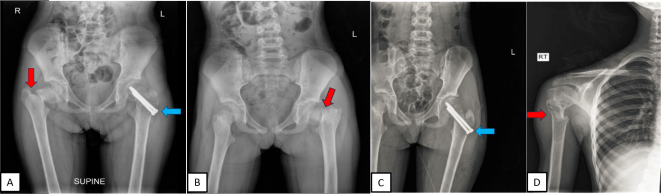



 Share This Article
 Twitter
 Linked In
 Facebook
 Copy
Copy Download