
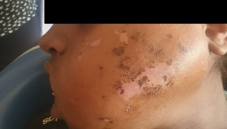
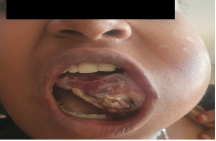
Background: Soft tissue sarcomas (STSs) are rare malignancies. This type of tumor can cause airway obstruction, anatomical distortion, voice changes, and limitations in opening the mouth, which may complicate intubation or ventilation. Difficult airway management in oral and maxillofacial surgery focuses on maintaining airway reflexes and spontaneous breathing. This case report describes a novel approach to awake nasal intubation in a postpartum woman with left mandibular soft tissue sarcoma. Unlike previous studies that relied on ultrasound or bronchoscopic guidance for awake intubation, this report describes successful blind awake intubation using a transtracheal block. Case presentation: This is a 20-year-old gravida I, para I woman who presented with swelling on the left side of her face for five months. She presented with these symptoms 3 weeks after spontaneous vaginal delivery. The swelling started on the buccal mucosa as a small lesion prior to delivery. After the airway was anesthetized with 5 ml of 2% lidocaine gargle and 5 ml of 2% lidocaine injected through the cricothyroid membrane, awake, blind nasal intubation was successfully conducted. Conclusion: Effective management of difficult airways requires a well-planned strategy, multidisciplinary team discussion, and preoperative assessment. This case report contributes to the literature by demonstrating successful awake blind nasal intubation facilitated by a transtracheal block using 5 ml of 2% lidocaine administered at the cricothyroid membrane. In situations with limited resources, awake blind nasal intubation with a transtracheal block can be a valuable and practical technique for managing difficult intubations. However, it requires a trained and experienced anesthetist.
| Published in | World Journal of Medical Case Reports (Volume 7, Issue 2) |
| DOI | 10.11648/j.wjmcr.20260702.11 |
| Page(s) | 23-28 |
| Creative Commons |
This is an Open Access article, distributed under the terms of the Creative Commons Attribution 4.0 International License (http://creativecommons.org/licenses/by/4.0/), which permits unrestricted use, distribution and reproduction in any medium or format, provided the original work is properly cited. |
| Copyright |
Copyright © The Author(s), 2026. Published by Science Publishing Group |
Awake Intubation, Difficult Airway, Nasal Intubation, Postpartum, Soft Tissue Sarcoma, Transtracheal Block
Investigation type | Value | Normal range | Investigation (RFT and LFT type | Reference range | Investigation LFT |
|---|---|---|---|---|---|
WBC | 9.3 mm3 | 4-11 | Creatinine | 0.42 | 0.5-0.9mg/dl |
Lym# | 1.9 mm3 | 1-6 | Blood urea nitrogen | 19.12 | 15-50mg/dl |
MID# | 1.3 mm3 | 0.1-2.5 | AST | 24.01 | 0-40u/l |
Gran# | 6.1mm3 | 2-10 | ALT | 18.96 | 0-40u/l |
Gran% | 64.3% | 50-60 | ALP | 104.48 | 65-270u/l |
MID% | 14.5% | 1-10 | Bilirubin direct | 0.08 | 0-0.3mg/dl |
Lym% | 21.1% | 20-40 | Bilirubin total | 0.52 | 0-0.12mg/dl |
RBC | 3.67×106 mm3 | 3.5-5.5 | Total protein | 8.07 | 6.6-8.7mg/dl |
Hgb | 11.4g/dl | 11.5-18 | Albumin | 3.85 | 3.5-5g/dl |
Hct | 36.6% | 34-55 | PTT | 26.2 | 23.4-40sec |
MCV | 99.9fl | 80-100 | PT | 13.7 | 10-15 sec |
MCH | 31pg | 23-40 | |||
MCHC | 31.1g/dl | 25.5-50 |
Vital sign | Time (A.M) | ||||||||
|---|---|---|---|---|---|---|---|---|---|
8:20 | 8:30 | 8:40 | 8:50 | 9:00 | 9:10 | 9:20 | 9:30 | 9:40 | |
BP | 119/56 | 119/68 | 100/56 | 120/59 | 138/70 | 150/70 | 132/70 | 139/65 | 129/68 |
PR | 110 | 110 | 80 | 70 | 65 | 90 | 89 | 70 | 87 |
SPO2 | 100 | 100 | 100 | 99 | 100 | 99 | 99 | 100 | 99 |
Ecg | SR | SR | SR | SR | SR | SR | SR | SR | SR |
ALT | Alanine Aminotransferase |
AST | Aspartate Aminotransferase |
ATR | Alpha- Thalassemia Retardation X-linked |
BP | Blood Pressure |
NICE | National Institute of Health and Clinical Excellence |
PACU | Post Anesthesia Care Unit |
RR | Respiratory Rate |
STS | Soft Tissue Sarcoma |
TP | Protein Tumor |
| [1] | Abeshouse A, Adebamowo C, Adebamowo SN, Akbani R, Akeredolu T, Ally A, et al. Comprehensive and Integrated Genomic Characterization of Adult Soft Tissue Sarcomas. Cell. 2017; 171(4): 950-965. e28. |
| [2] | Dangoor A, Seddon B, Gerrand C, Grimer R, Whelan J, Judson I. UK guidelines for the management of soft tissue sarcomas. Clin Sarcoma Res. 2016; 6(1): 1-26. |
| [3] | Swain SK, Das A, Madhumita M, Sahu MC. Egyptian Journal of Ear, Nose, Throat and Allied Sciences A giant oropharyngeal synovial sarcoma threatening the supraglottic airway - A case report. Egypt J Ear, Nose, Throat Allied Sci. 2017; 18(3): 321-4. Available from: |
| [4] | Barak M, Bahouth H, Leiser Y, El-naaj IA. Airway Management of the Patient with Maxillofacial Trauma : Review of the Literature and Suggested Clinical Approach. 2015; 2015. s |
| [5] | Romanian Journal of Medical and Dental Education: Surgery M facial. MANAGEMENT OF DIFFICULT AIRWAY IN ORAL AND MAXILLO- FACIAL SURGERY. 2020; 9(5). |
| [6] |
Anesth J, Crit A, Merola R, Vargas M, Battaglini D, Airway K. Airway management for oral cancer surgery : a multidisciplinary patient based approach is needed. 2025;
https://link.springer.com/article/10.1186/s44158-025-00270-x |
| [7] | Sandefur BJ, Driver BE, Long B. Managing Awake Intubation. Ann Emerg Med. 2025; 85(1): 21-30. Available from: |
| [8] | Chavan G, Chavan AU, Patel S, Gaikwad P. Airway Blocks Vs LA Nebulization- An interventional trial for Awake Fiberoptic Bronchoscope assisted Nasotracheal Intubation in Oral Malignancies. 2020; 21: 3613-7.9. |
| [9] | Zheng J, Du L, Du B, Zhang W, Zhang L, Chen G. Airway nerve blocks for awake tracheal intubation : A meta-analysis of randomized control trials and trial sequential analysis. 2023; 88(37). |
| [10] | Huang S. Hui, Bai J, Jin J, Hua Y. Fang. Nasotracheal intubation in an angiosarcoma-related difficult airway : a case presentation. 2022; 12(6): 5492-5. |
| [11] | The ANNALS of AFRICAN SURGERY. MbChb MCM, BDS KK, MBS KC. Blind Naso-Endotracheal Intubation: 43-6. |
| [12] | De Carli D, Correa NS, Silva TCBV, Maradei EM. Blind nasotracheal intubation in awaken patient scheduled for hemimandibulectomy. Case report. Rev Bras Anestesiol. 2008; 58(1): 55-62. |
| [13] | Etemadi SH, Bahrami A, Farahmand AM, Zamani MM. Sitting nasal intubation with fiberoptic in an elective mandible surgery under general anesthesia. Anesthesiol Pain Med. 2015; 5(6): 5-8. |
| [14] | Jung, Hoo A comprehensive review of difficult airway management strategies for patient safety. Review. 2023: 18(4): 331-339. Anesth Pain Med, |
APA Style
Asefa, T., Abebe, M., Ahmed, Y., Ahmed, E. (2026). Successful Awake Nasal Intubation for Difficult Airway Management in a Postpartum Woman Who Presented with Left Mandibular Soft Tissue Sarcoma: A Case Report. World Journal of Medical Case Reports, 7(2), 23-28. https://doi.org/10.11648/j.wjmcr.20260702.11
ACS Style
Asefa, T.; Abebe, M.; Ahmed, Y.; Ahmed, E. Successful Awake Nasal Intubation for Difficult Airway Management in a Postpartum Woman Who Presented with Left Mandibular Soft Tissue Sarcoma: A Case Report. World J. Med. Case Rep. 2026, 7(2), 23-28. doi: 10.11648/j.wjmcr.20260702.11
@article{10.11648/j.wjmcr.20260702.11,
  author = {Tesfaye Asefa and Minda Abebe and Yusuf Ahmed and Ebrahim Ahmed},
  title = {Successful Awake Nasal Intubation for Difficult Airway Management in a Postpartum Woman Who Presented with Left Mandibular Soft Tissue Sarcoma: A Case Report},
  journal = {World Journal of Medical Case Reports},
  volume = {7},
  number = {2},
  pages = {23-28},
  doi = {10.11648/j.wjmcr.20260702.11},
  url = {https://doi.org/10.11648/j.wjmcr.20260702.11},
  eprint = {https://article.sciencepublishinggroup.com/pdf/10.11648.j.wjmcr.20260702.11},
  abstract = {Background: Soft tissue sarcomas (STSs) are rare malignancies. This type of tumor can cause airway obstruction, anatomical distortion, voice changes, and limitations in opening the mouth, which may complicate intubation or ventilation. Difficult airway management in oral and maxillofacial surgery focuses on maintaining airway reflexes and spontaneous breathing. This case report describes a novel approach to awake nasal intubation in a postpartum woman with left mandibular soft tissue sarcoma. Unlike previous studies that relied on ultrasound or bronchoscopic guidance for awake intubation, this report describes successful blind awake intubation using a transtracheal block. Case presentation: This is a 20-year-old gravida I, para I woman who presented with swelling on the left side of her face for five months. She presented with these symptoms 3 weeks after spontaneous vaginal delivery. The swelling started on the buccal mucosa as a small lesion prior to delivery. After the airway was anesthetized with 5 ml of 2% lidocaine gargle and 5 ml of 2% lidocaine injected through the cricothyroid membrane, awake, blind nasal intubation was successfully conducted. Conclusion: Effective management of difficult airways requires a well-planned strategy, multidisciplinary team discussion, and preoperative assessment. This case report contributes to the literature by demonstrating successful awake blind nasal intubation facilitated by a transtracheal block using 5 ml of 2% lidocaine administered at the cricothyroid membrane. In situations with limited resources, awake blind nasal intubation with a transtracheal block can be a valuable and practical technique for managing difficult intubations. However, it requires a trained and experienced anesthetist.},
 year = {2026}
}
TY  - JOUR
T1  - Successful Awake Nasal Intubation for Difficult Airway Management in a Postpartum Woman Who Presented with Left Mandibular Soft Tissue Sarcoma: A Case Report
AU  - Tesfaye Asefa
AU  - Minda Abebe
AU  - Yusuf Ahmed
AU  - Ebrahim Ahmed
Y1  - 2026/07/17
PY  - 2026
N1  - https://doi.org/10.11648/j.wjmcr.20260702.11
DO  - 10.11648/j.wjmcr.20260702.11
T2  - World Journal of Medical Case Reports
JF  - World Journal of Medical Case Reports
JO  - World Journal of Medical Case Reports
SP  - 23
EP  - 28
PB  - Science Publishing Group
SN  - 2994-726X
UR  - https://doi.org/10.11648/j.wjmcr.20260702.11
AB  - Background: Soft tissue sarcomas (STSs) are rare malignancies. This type of tumor can cause airway obstruction, anatomical distortion, voice changes, and limitations in opening the mouth, which may complicate intubation or ventilation. Difficult airway management in oral and maxillofacial surgery focuses on maintaining airway reflexes and spontaneous breathing. This case report describes a novel approach to awake nasal intubation in a postpartum woman with left mandibular soft tissue sarcoma. Unlike previous studies that relied on ultrasound or bronchoscopic guidance for awake intubation, this report describes successful blind awake intubation using a transtracheal block. Case presentation: This is a 20-year-old gravida I, para I woman who presented with swelling on the left side of her face for five months. She presented with these symptoms 3 weeks after spontaneous vaginal delivery. The swelling started on the buccal mucosa as a small lesion prior to delivery. After the airway was anesthetized with 5 ml of 2% lidocaine gargle and 5 ml of 2% lidocaine injected through the cricothyroid membrane, awake, blind nasal intubation was successfully conducted. Conclusion: Effective management of difficult airways requires a well-planned strategy, multidisciplinary team discussion, and preoperative assessment. This case report contributes to the literature by demonstrating successful awake blind nasal intubation facilitated by a transtracheal block using 5 ml of 2% lidocaine administered at the cricothyroid membrane. In situations with limited resources, awake blind nasal intubation with a transtracheal block can be a valuable and practical technique for managing difficult intubations. However, it requires a trained and experienced anesthetist.
VL  - 7
IS  - 2
ER  -
Department of Anesthesia, Madda Walabu University, Bale Robe, Ethiopia
Department of Anesthesia, Hawassa University, Hawassa, Ethiopia
Department of Anesthesia, Hawassa University, Hawassa, Ethiopia
Department of Anesthesia, Madda Walabu University, Bale Robe, Ethiopia

Information



 Share This Article
 Twitter
 Linked In
 Facebook
 Copy
Copy Download